
Have you ever noticed that you can cope with almost anything, but the moment you stop, you can’t seem to relax?
You get restless. You reach for your phone. You start thinking about everything that could go wrong tomorrow.
There’s a reason doing nothing can feel surprisingly difficult.
When you’ve spent a long time living with tension, it can become so familiar that you stop noticing it’s there. You might understand what’s happened to you. You might even feel that you’ve moved on. But the tension is still there, and you can’t seem to make it go away.
So why is it so hard to relax, even when you know you’re safe?
Why doesn’t understanding trauma make the tension go away?
The way I understand this through my work is that trauma affects the body’s biology. It’s not just something you remember or think about. It can become a state that the body continues to hold.

You might have spent years talking about what happened. You might understand why you feel the way you do and have been given different things to help you move through it.
When we experience a shock, something can happen within us that we don’t simply talk our way out of.
Think about the smaller experiences that build up over time. Someone repeatedly dismisses you. You’re not listened to. You feel disrespected, or learn that expressing yourself isn’t welcome.
Each experience might seem insignificant on its own. But something in you registers it. Over time, those experiences can contribute to the beliefs, patterns and ways of coping that you carry into adulthood.
Then there are the bigger, more sudden experiences. I think of little-t trauma as shocks that build over time, whereas big-T trauma can be more like an earthquake. One can develop gradually, the other can happen in an instant.
Either way, the effects can stay with you long after the experience itself has passed.
You might know that you’re no longer in that situation. You might understand why you respond in a particular way. But you can still find yourself tense, on edge or unable to settle.
Is this just being a tense person, or is it something else?
There’s a healthy kind of tension. You’re about to give a presentation, or you’re waiting for news, and your body tightens. That’s normal. It comes up, and once the event has passed, it goes again.
What I’m describing is different. It’s a body that’s still bracing against something that isn’t happening anymore.
Someone in that state is often functioning very well in their everyday life. From the outside, you might not see anything at all. But it comes across in how they interact, and it most definitely comes across when I get my hands on them in a healing.
The difference isn’t really about how tense you feel. It’s about whether the tension ever fully lets go.
How does tension become your comfort zone?
One of the ways I explain this is through concrete.
With little-t trauma, imagine concrete that sets very slowly. Experiences build up, one after another, until certain patterns become deeply established.
With big-T trauma, imagine fast-setting concrete. The shock happens, and things can become fixed very quickly.
In my work, I’ve encountered people whose systems feel almost locked in. It’s like bouncing a ball off a wall. Usually I feel someone’s energy system open up very gently, and that’s my way in. But sometimes there’s resistance, and I have to drill energetically. It’s the only way I can describe it.
Often, that resistance isn’t conscious. The person wants to be there. They want things to change. But wanting something to change and being able to let go of what’s familiar are two different things.
People stop noticing their tension because it literally becomes the comfort zone. They’ve forgotten what it feels like to be relaxed, and forgotten what it takes for the body to get there.
I don’t mean that the tension feels comfortable. It might be painful. It might leave you exhausted. You might be desperate to get rid of it.
But it’s familiar.
If you’ve spent years keeping busy, staying in control or pushing difficult feelings aside, changing that can feel frightening. Letting go can mean allowing yourself to feel things you’ve spent years trying not to feel.
That can be difficult, even when you know you want to move forward.
But the fact that a pattern has been there for a long time doesn’t mean it has to stay there forever.
Why is it so often worse at night, lying in bed?
One reason tension can feel worse at night is that you finally stop.

During the day, you’re busy. You’re working, looking after other people, answering messages, making decisions and dealing with whatever comes your way. There is always something to focus on.
Then you get into bed, and suddenly there is nothing else to do.
Without all those distractions, you may become more aware of what’s happening inside you. Thoughts can come up. Feelings can surface. The tension you’ve been carrying all day can become much harder to ignore.
For some people, the instinct is to reach for their phone, put something on in the background or find another way to keep their mind occupied.
I’m not saying you should never listen to something before bed, or that you have to lie there with your thoughts every night. But if you’re always filling the quiet, it may be worth noticing what happens when you give yourself a little space instead.
Can you lie in bed for a few minutes without immediately reaching for your phone or putting something on?
What do you notice?
You don’t need to force anything to happen. Simply becoming aware of what comes up when you stop can tell you something about how difficult it feels for you to slow down.
Why does the tension come back after a massage?
A bath, a massage, a bit of stretching or some gentle yoga can help your body relax. I’m not suggesting you stop doing things that make you feel better.
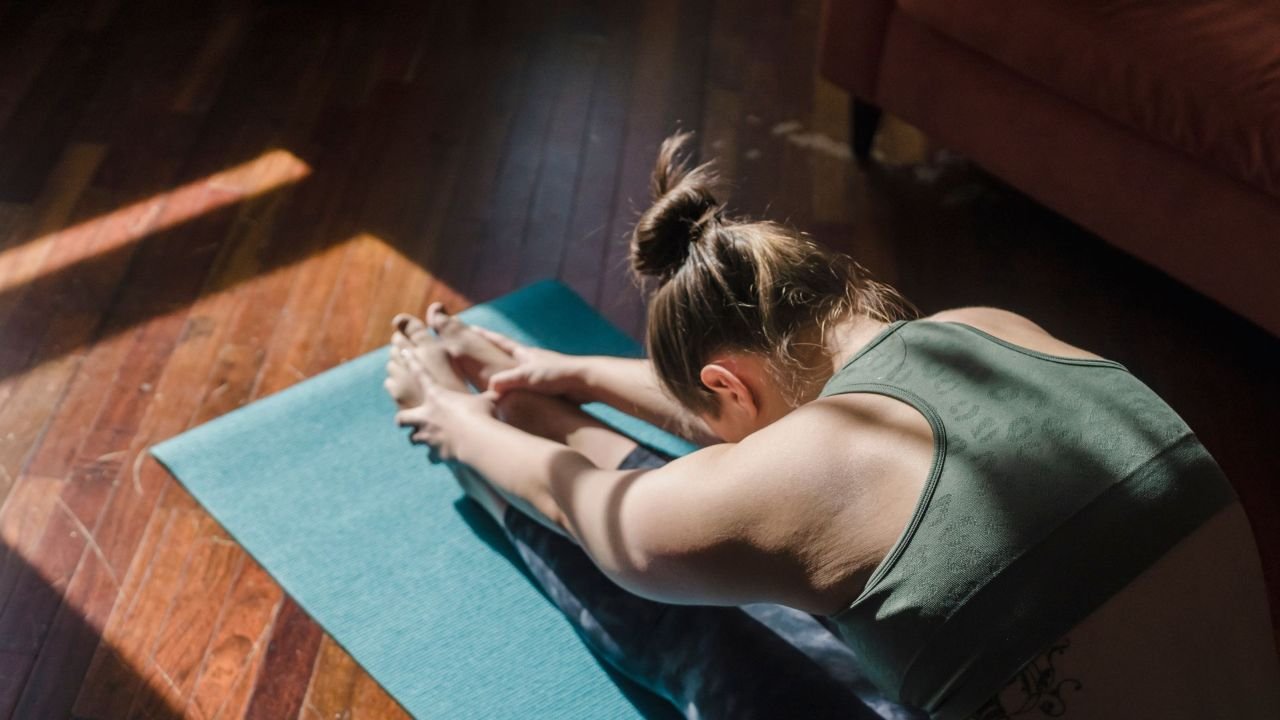
The difficulty is that these things may only help temporarily if the underlying issue hasn’t been addressed.
You might have a massage, feel looser afterwards and enjoy a day without quite so much tension. Then, before long, your shoulders are back up by your ears.
Or you might do some yoga, feel more relaxed for an evening and then find yourself clenching your jaw again the following morning.
If the tension is connected to something deeper, it makes sense that the relief might not last. That doesn’t mean the massage or yoga was pointless. It means you may need to look at more than the physical tension itself.
Consistency can also make a difference. If yoga feels helpful, I would generally favour five to ten minutes a day over an hour once a week. A small amount that you do regularly can be much more useful than doing a lot occasionally.
You don’t need to turn relaxation into another big task. But it is worth paying attention to what helps, how long the benefit lasts, and whether the same tension keeps returning.
What does it feel like when tension finally releases?
This is where things can look very different from one person to another.
In my healing work, I sometimes ask people to say “I let go.”
It’s a simple sentence, but I’ve found it can be incredibly powerful. For some people, saying it is easy. For others, it can bring up a lot of emotion, particularly when there’s grief involved.
If someone finds it too difficult, I don’t insist that they say it. We work in another way.
But when a person is able to say it, I sometimes experience what feels like rushes of energy leaving their system. The image I use is a water hose, or even a geyser. That’s how strong it can feel to me during a session.
People may cry. They may feel vulnerable or embarrassed. They might not enjoy the experience in the moment, even if something important is shifting for them.
I always remind people that crying is one of the healthiest things we can do. We don’t have to be embarrassed about it.
I think there’s something important about allowing ourselves to feel what we’re feeling, rather than immediately distracting ourselves from it.
As I often say, our deepest pain turns into wisdom.
I believe that when something painful is genuinely transformed, it can change the way we understand ourselves and our experiences. That doesn’t mean the pain was necessary, or that we should have to suffer to learn something. It means that what we’ve been through doesn’t have to remain something we can only carry.
Sometimes, we can come to understand it differently.
A client whose body wouldn’t let go
I recently worked with a woman who knew she was holding a lot emotionally, but neither of us knew quite how much.
During the session, she cried throughout. Afterwards, she experienced uncontrollable tears for two to three days. I stayed in close contact with her while she worked through that period.
As things began to settle, she recognised that she was grieving her father, who had died 13 years earlier, alongside years of difficult experiences.
It was a lot to come up.
I was careful to support her and give her space to come to terms with what she was experiencing. Emotional release can be intense, and people need to be supported through it rather than made to feel they should simply get on with things.
Then, after those first few days, she told me she’d had the opportunity to go to an all-day disco.
She went and danced until she dropped.
I was delighted to hear that.
It’s a reminder that what happens during a session isn’t always the whole story. Sometimes, there can be a difficult period as emotions come up. Sometimes, people notice physical changes. And sometimes, the change shows up in what they feel able to do afterwards.
Everyone’s experience is different. I would never promise that a session will produce a particular response, and I don’t think anyone should feel they have to force an emotional release.
But I do believe that change is possible, even when something has been held for a very long time.
Can a body that’s been tense for decades actually change?
Yes. Absolutely.

I’ve seen people experience a significant change in how they feel within their bodies. Sometimes it happens quite quickly. Other times, it’s a more gradual process.
If your muscles have been tense for years, regular gentle movement can be helpful alongside working with the deeper issues that may be contributing to that tension.
You don’t have to do everything at once. You don’t have to force yourself into a big emotional experience. And you don’t have to decide that because you’ve been tense for twenty years, you’ll always be tense.
What matters is beginning to understand what’s happening for you and finding the right way to work with it.
If you’re used to being on edge, relaxing may feel unfamiliar at first. That doesn’t mean you’re broken, and it doesn’t mean you can’t change.
It means there’s something worth paying attention to.
What if I understand my patterns but still can’t let go?
You may already have spent years trying to understand yourself. You might know where your reactions come from, recognise the experiences that shaped you and understand why you find it difficult to switch off.
But knowing all of that doesn’t necessarily mean the tension will disappear.
In my work, I look at what may still be held within the body and energy system, rather than relying on talking and understanding alone. My one-to-one healing work gives people space to explore those deeper patterns and work with what may still be keeping them in place.
You don’t need to arrive knowing exactly what needs to change. And you don’t need to have all the answers before you begin.
If you’ve tried different things and still feel as though you’re carrying something you can’t quite put down, it may be worth exploring a different approach.
Because you don’t have to spend the rest of your life simply managing the tension. And perhaps the first step is recognising that the way you’ve learned to cope isn’t necessarily the way you have to keep living.
For a lot of people, that means looking further back than they expect, at experiences they’ve never really counted as significant. That’s what I’ve written about here: Can you have trauma if nothing bad enough happened?